


Looking Up
New episodes released every other Friday!
Join Dean Regas, astronomer, author, and space expert on a journey through the stars! Guests from all over the globe bring their knowledge and passion about today’s latest scientific discoveries and advancements. From eclipses to supernovas, from rockets to rovers; there’s a whole universe to explore! Dean is the author of “How to Teach Grown-Ups About Pluto” and “100 Things to See in the Night Sky” and was the longtime host of PBS' Stargazers television program. Looking Up is a production of Cincinnati Public Radio.
Subscribe:
-
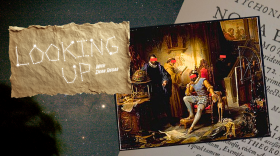 On a special episode of Looking Up, host Dean Regas tests a new format as he investigates the mysterious 1601 death of astronomer Tycho Brahe. Science writer Dava Sobel, comedian and actor Thomas Lennon, and WVXU newsroom members Tana Weingartner, Maryanne Zeleznik, Becca Costello, Bill Rinehart, and Jennifer Merritt join the search for answers. Part II publishes Oct. 23, 2026.
 -
 When NASA and other space agencies release sounds from space, what are we actually hearing? The answer: data sonifications. Scientists take data from telescopes, often across multiple wavelengths of light, and translate them into audible soundscapes. Host Dean Regas talks with Mara Helmuth, a composer and professor of music at the University of Cincinnati College-Conservatory of Music, about how researchers turn cosmic data into music.
 -
 The sun is our closest laboratory for understanding how stars work. Decades of space missions have studied the sun, yet its outer atmosphere, the corona, remains a mystery. NASA's Parker Solar Probe was built to change that. Dean Regas talks with Dr. Joe Westlake, heliophysics division director at NASA Headquarters, about what we're learning from humanity's closest approach to a star.
 -
 Astronomers say the shiny new Vera C. Rubin Telescope will be able to map the entire universe with remarkable precision in no time. Already, it has located tens of thousands of asteroids close to home. Dean Regas chats with Dr. Mario Jurić, the solar system lead scientist for the Vera Rubin Observatory in Chile, to find out more.
 -
 What really happened when Pluto was demoted? Twenty years after the International Astronomical Union's 2006 vote, Dean Regas revisits the decision that reshaped our solar system, with insider accounts from science writer Dava Sobel and astronomer Bob Stencel.
 -
 Chasing solar eclipses is a great excuse to travel. In 2026, August 12th's eclipse presents a challenge: which beautiful destination offers the best view? The path of totality will be visible in both Spain and Iceland. Join Dean as he makes his decision, and pays tribute to a poignant song he's come to love.
 -
 Still buzzing with excitement from the Artemis II launch, Dean Regas waxes poetic about that special view of our home planet that only astronauts get to see. A chat with NASA astronaut Tracy Dyson is the closest experience to the real thing.
 -
 What is a potentially hazardous asteroid like? Up close and personal? Very few space missions have visited asteroids and fewer still have touched an asteroid and brought some of it back to Earth. Dean chats with NASA's OSIRIS-REx mission's image processing lead scientist, Dr. Daniella Mendoza DellaGiustina, to learn more. Let’s go to the asteroid Bennu!
 -
 How do you feel about the universe? Is it scary, you know with how large it is? How far way everything is? Is it intimidating when astronomers talk about time in millions and billions of years? Okay, on the surface it’s intimidating. But there are lots of people out there who have made it their mission, sometimes dedicating years to volunteering, and a few well-paying careers, just to bring the universe down to Earth. Dean Regas chats with Kat Troche, project coordinator for the Astronomical Society of the Pacific, to learn more.
 -
 By some counts as much as 96% of everything in the universe comes from dark matter and dark energy. And, up to now, both are completely invisible. Few in the field question this theory, but could there be alternatives? Dean chats with Professor Stacy McGaugh from the Department of Astronomy at Case Western Reserve University to learn more.


